Use case
Coach engineers on AI coding — with evidence, not vibes
Two of your engineers are great with agents; the rest paste snippets into a chat box. How to coach engineers on AI coding with session evidence, not vibes.
You already know the shape of the problem. Two people on your team are different animals with agents: they plan before they code, they delegate work to subagents, they keep their context clean. The rest are pasting snippets into a chat box and calling it AI-assisted development. Same tools, same licenses, wildly different results.
You've probably already tried the obvious things. A lunch-and-learn where your best person demos their workflow. A shared doc of prompts. The room nods, the doc gets three views, and a month later the gap is exactly where it was. Watching a demo isn't the same as changing how you work on Tuesday afternoon with a real ticket.
And you can't fix it by observation, because there's nothing to observe. You can't sit behind eight people while they work. So coaching runs on self-report — "yeah, I've been using plan mode" — and vibes. You're a coach who has never seen the team play.
You can't coach what you can't see
Every discipline that takes coaching seriously starts from the same place: the coach watches the rep.
A swim coach watches the stroke. A music teacher listens to the playing, not a description of it. Sales teams record calls and review them together — that's the whole mechanism. Nobody coaches from the athlete's own summary of training, because people are reliably bad narrators of their own technique.
Engineering has never had this for AI work. The session — where the actual skill is exercised — happens privately, in a terminal, and until recently left no durable record. Standard metrics see nothing: PR counts, DORA, seat licenses all look identical whether someone is running a disciplined agent workflow or fighting a chatbot for an hour. The skill is real, but it's invisible.
Session data changes that. Claude Code writes a transcript of every session; Accrete parses those transcripts and makes the work observable — what was asked, what the agent did, which practices showed up. The coach can finally watch the rep. The pipeline is laid out on how it works, including what stays on each developer's machine.
Make "she's just good at it" legible
Ask anyone on your team why your strongest engineer gets so much out of agents and you'll get a shrug: she's just good at it. That answer is useless for coaching, because you can't teach "good at it."
Accrete's practice catalog replaces the shrug with named, observable behaviors: planning before coding, delegating to subagents, using skills and saved commands, task tracking, memory and context management, committing work, producing written artifacts. Either a session shows the behavior or it doesn't — no sentiment scores, no proxies.
Run your team's sessions through that lens and the mystery dissolves into a list. Your two strong engineers aren't smarter; they do specific things the others don't. Some of those things won't even be in our catalog yet — the matrix is also how you discover the practices your own team invented.
Each person's next practice
The adoption matrix is the coaching agenda: per-person × per-practice, who has picked up what. Read down a column and you see which practices the team plateaus on. Read across a row and you see one engineer's actual repertoire — and the obvious next practice for them to pick up. Not "get better at AI," which is uncoachable, but "you've never used plan mode on a refactor; try it on the next one."
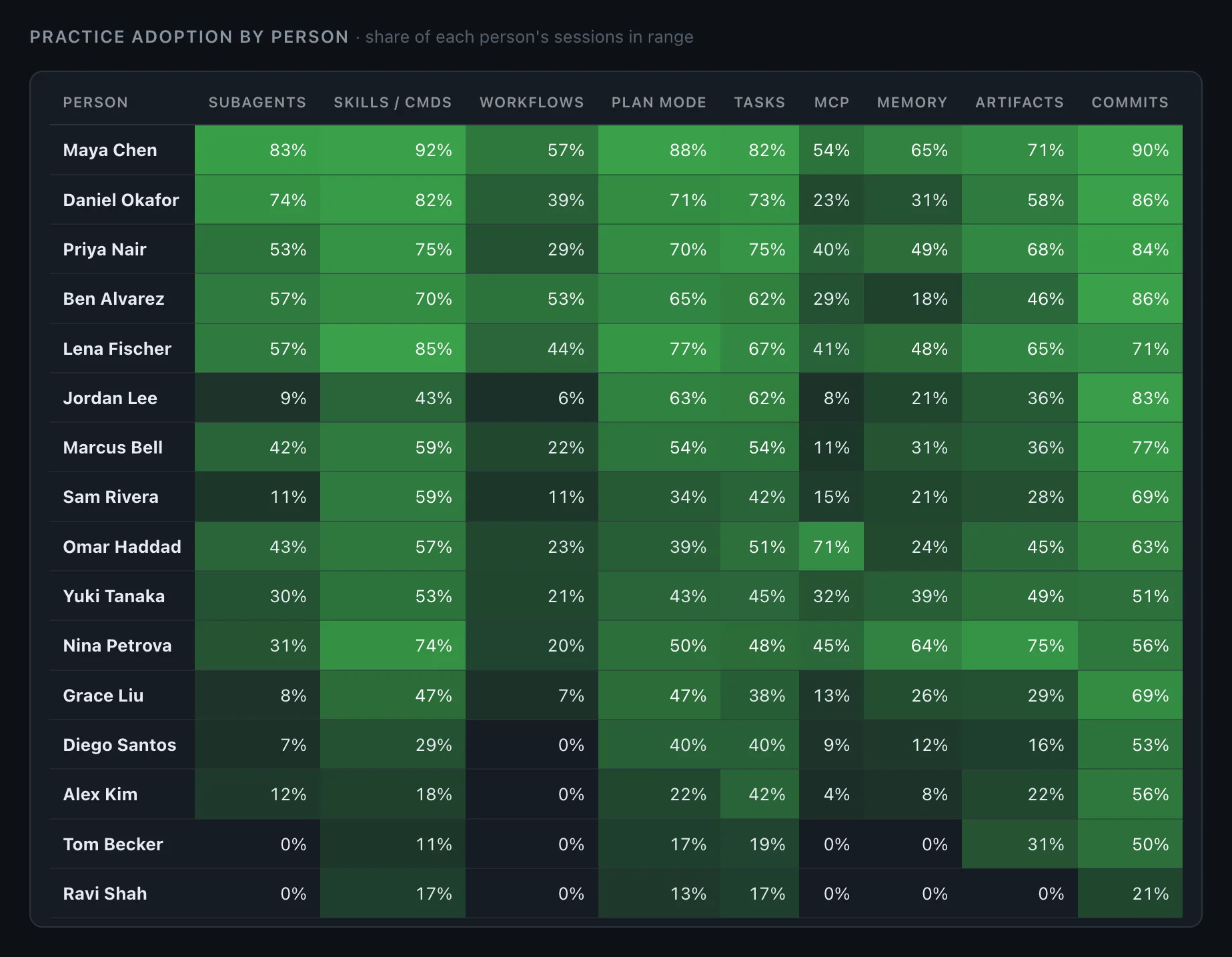
One caveat worth volunteering: adoption is not proficiency. The matrix shows a practice appeared in someone's sessions, not that they're good at it yet. We track those separately on purpose — "tried it once" starting the conversation is the win; depth comes with reps.
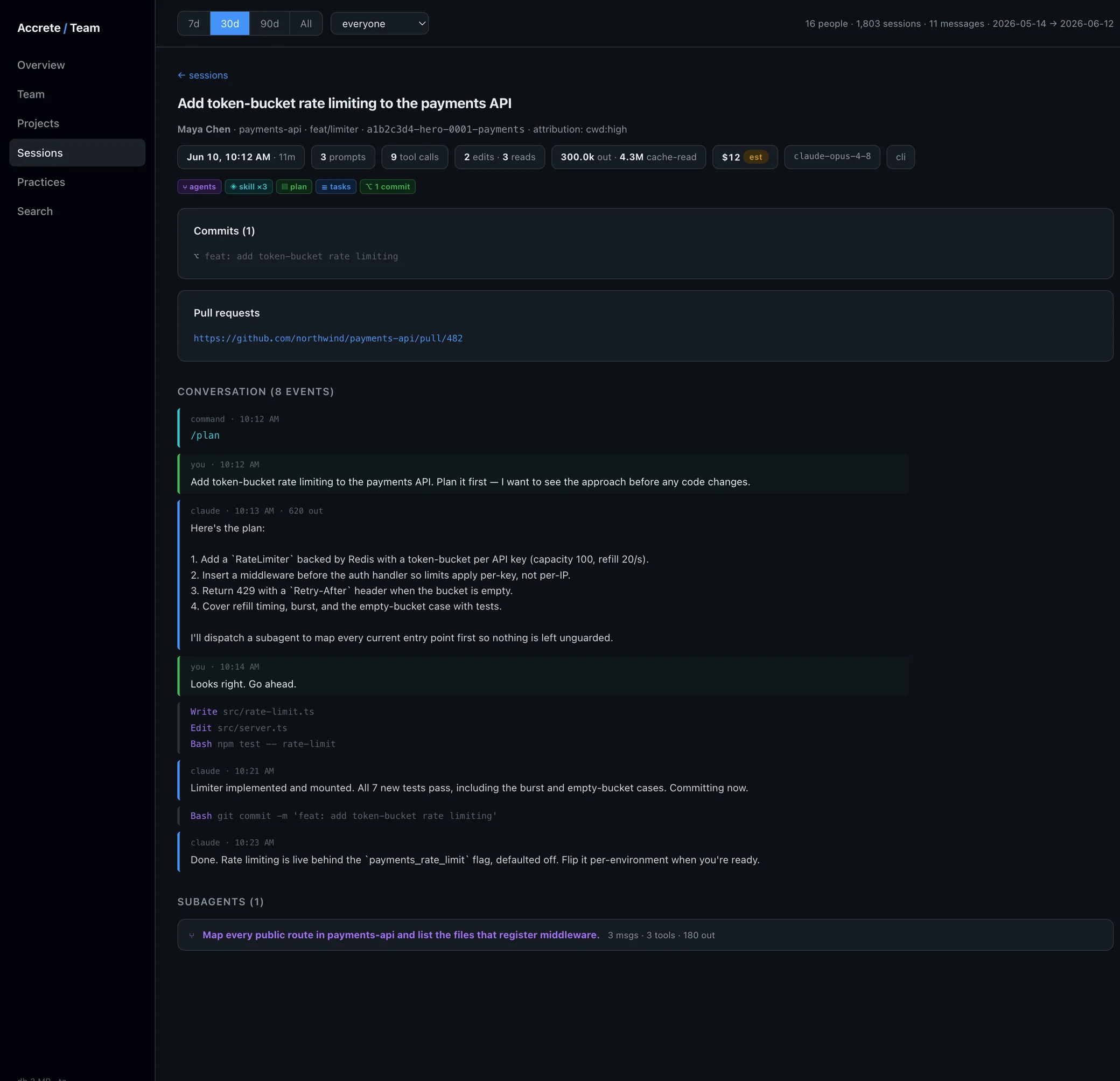
Then session drill-down gives you teaching material no slide deck can match: real examples from your own codebase. Pull up your strongest engineer's session on the gnarly migration — with their blessing — and walk through how they broke it down. That lands in a way a generic demo never does, because it's your code, your conventions, your kind of problem. A full playbook for running these conversations is in our guide to coaching engineers on AI tools.
This is for development, not review
Say it to your team plainly, then keep the promise: this is coaching infrastructure, not a performance file. The matrix exists to find coaching opportunities and unnoticed expertise — including people quietly doing something clever nobody knew about — not to rank developers. The moment session data feeds a performance review, people will game it and the data goes dead. Our privacy page covers what's captured, what isn't, and where your data lives: one isolated database per company, parsed session data only, never raw transcript files.
Start with your own team's sessions
We're pre-launch, working with a small set of teams. Join the early access list — or become a design partner and work directly with the founder, shaping the practice catalog around what your team actually does.